
Spring Plant Health Assessments: Why Early Evaluation Matters
A spring plant health assessment is a structured evaluation of your trees, shrubs, and landscape plants performed after winter dormancy ends. Its purpose is straightforward: find damage, disease, and stress before those problems cost you real money. Most homeowners wait until something looks obviously wrong. By then, they're paying for removal instead of treatment.
A professional spring plant health assessment typically costs $100 to $250 and takes 30 to 60 minutes per property. It covers branch integrity, bark condition, root zone health, soil compaction, and early disease markers. This single visit can prevent failures that lead to $750 or more in emergency tree removal.
I've worked on landscape projects where a $150 spring evaluation saved the client north of $3,000 in removals and replanting. And I've seen the flip side, where homeowners who skipped evaluations for two or three years ended up gutting half their mature plantings. The math always favors early action.
This article won't cover general gardening tips or seasonal flower planting. We're focused specifically on assessing the health of established trees, shrubs, and woody plants after winter. If you have a landscape that needs seasonal care beyond health evaluations, that's a separate conversation.
What Does a Spring Plant Health Assessment Actually Include?
A spring plant health assessment is a top-to-bottom inspection of your landscape's woody plants, performed by a trained arborist or plant health care specialist. It isn't a quick glance from the driveway.
The evaluation starts at the canopy and works down. Your arborist checks for dead or broken branches, cracks in major limbs, and signs of structural weakness like co-dominant stems. Then they move to the trunk, looking for bark splits, cankers, fungal fruiting bodies, and entry points for boring insects. Below ground, they assess root flare exposure, soil compaction, and drainage conditions.
Most homeowners don't realize how much a trained eye catches that you'll miss. Internal decay, for example, doesn't show on the surface until it's advanced. A pro with a sounding mallet or resistograph can detect soft wood inside a trunk that looks perfectly fine from the outside. Penn State Extension's guide on diagnosing plant health problems walks through the systematic approach professionals use. The difference between a DIY walkthrough and a certified evaluation is the difference between a gut feeling and an actual diagnosis.
Here's a contrarian take most companies won't give you: if you have a small property with young plantings (under 5 years old, all under 10 feet tall), you probably don't need a paid assessment every single spring. Young, small plants rarely have the structural issues that make assessments high-value. Where assessments earn their cost is on properties with mature trees, specimens over 15 feet, or anything near a structure, driveway, or play area.
Why Is Spring the Right Time for Plant Health Evaluations?
Early spring, before full leaf-out, gives you the clearest view of your plants' structure. Once foliage fills in, cracks, deadwood, and structural failures hide behind a wall of green. That's why certified arborists prefer evaluations between late March and mid-May in most northern climates.
But timing matters for a second reason that fewer people talk about. Spring is when dormant diseases activate. Anthracnose, fire blight, apple scab, and dozens of fungal pathogens wake up as temperatures climb above 50°F with consistent moisture. If your arborist spots early signs of infection before the pathogen has spread through the canopy, targeted fungicide applications can actually work. Wait until June, and you're managing damage instead of preventing it.
The tree trimming services sector alone hit $39.5 billion in 2025, according to IBISWorld. That's a staggering number, and a huge share of that spend goes to reactive work, removing dead trees and cleaning up storm damage that earlier intervention could have prevented.
Actually, the framing of "spring cleaning for your trees" that most articles use isn't quite right. A better way to think about it is triage. You're sorting your plants into three categories: healthy and fine, needs treatment now, and needs monitoring over the season. That triage only works when you do it early enough to act on what you find. Properties with established fine gardening programs already have this built into their seasonal schedule.
What Winter Damage Should You Look for on Trees and Shrubs?
Winter damage on landscape plants falls into a few predictable categories, and knowing what to look for puts you ahead of 90% of homeowners.
Branch breakage is the most obvious. Ice storms and heavy snow loads snap limbs, especially on species with brittle wood like Bradford pears, silver maples, and birches. But don't just look for branches on the ground. Hanging, partially broken limbs (arborists call them "hangers") are the real danger. They can drop without warning weeks after the storm that caused them.
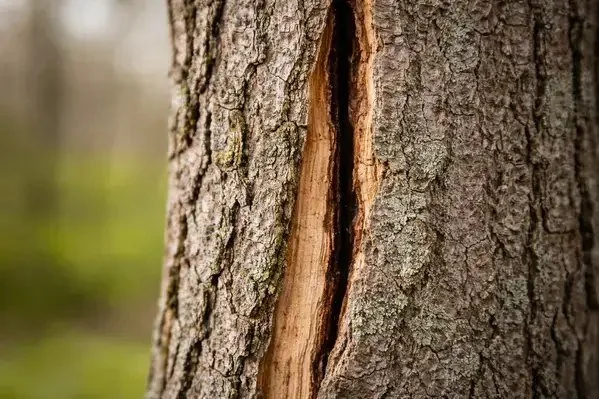
Frost cracks show up as vertical splits running along the trunk, usually on the south or southwest side where sun exposure creates the most temperature swings. According to the University of Minnesota Extension's guide on protecting trees from winter injury, these cracks happen when daytime warming causes bark to expand and overnight freezing contracts it rapidly. They often reopen year after year.
Animal damage catches people off guard. Deer rubbing, rabbit girdling, and vole damage at the base of young trees can kill a plant outright if the cambium layer is destroyed 360 degrees around the trunk. This is one area where a visual check works. If you see bark stripped in a ring around the base, that tree's vascular system may already be severed.
One thing most spring checklists skip: check your evergreens for winter burn. Browning on the south-facing side of arborvitae, boxwood, and rhododendrons is desiccation injury, not disease. The plant lost more moisture through its needles than frozen roots could replace. Most plants recover if the buds are still alive underneath.
How Do You Spot Early Disease in Spring?
Early disease detection is the single highest-value part of a spring plant health assessment. Catching a fungal infection at first leaf-out versus mid-summer can be the difference between a $50 treatment and a $2,000 removal.
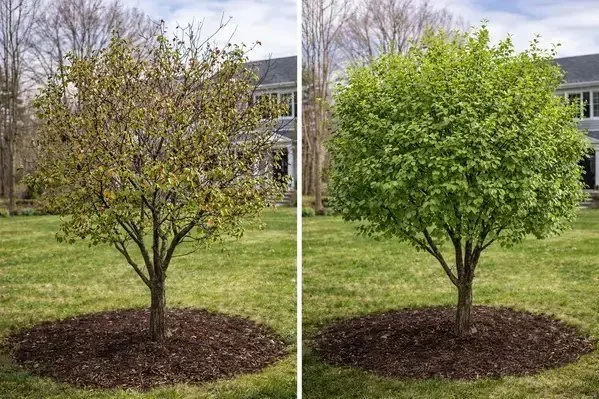
Fungal diseases leave signatures you can learn to read. Anthracnose shows as irregular brown or black lesions on new leaves, typically following veins. Apple scab appears as olive-green to brown velvety spots on leaf surfaces. Fire blight, common on ornamental pears and crabapples, turns new shoots black and curls them into a shepherd's crook shape.
But here's what catches most homeowners: not all spring leaf problems are disease. Nutrient deficiencies, herbicide drift, frost damage, and even normal leaf emergence can mimic disease symptoms. Yellowing between leaf veins usually signals iron or manganese deficiency, not infection. A professional landscape team or certified arborist can distinguish between the two in minutes. Misdiagnosing a nutrient issue as a disease (and spraying fungicide that won't help) is one of the most common DIY mistakes I see.
TCIA's 2025 industry conference featured sessions on building plant health care programs that emphasize diagnosis before treatment. That's the right order. Too many services skip straight to spray schedules without actually identifying what's wrong.
Does Soil Health Affect Spring Plant Recovery?
Absolutely, and it's the most overlooked piece of the assessment. Your soil is the foundation for everything above it. Compacted soil after a wet winter restricts root growth, limits oxygen exchange, and creates drainage problems that invite root rot.
A quick test: push a screwdriver into the soil around your trees. If it won't go in easily 6 to 8 inches, your soil is compacted. Foot traffic, equipment, and even heavy rain on clay soils all contribute. Properties with established landscape design programs often address this proactively with aeration and organic amendments.
Soil pH matters more than most people think. A pH that's too high locks out iron, manganese, and other micronutrients even when they're present in the soil. Acid-loving plants like azaleas, rhododendrons, and blueberries are especially sensitive. A simple $15 soil test from your local extension office tells you exactly where you stand.
The JCHS Improving America's Housing 2025 report found that roughly 3.52 million homeowners completed landscaping projects at an average of $3,698 each. What that number doesn't tell you is how many of those projects failed because the soil conditions were never assessed first. I've seen $10,000 plantings die within two seasons because nobody tested the soil pH before choosing species. That's an expensive lesson.
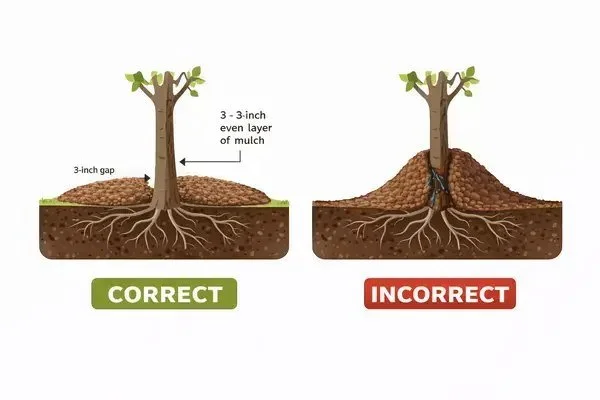
Mulch is your best friend here, but only if you do it right. A 2 to 3 inch layer of organic mulch spread from the drip line inward (but not touching the trunk) conserves moisture, moderates temperature, and feeds soil biology as it breaks down. Volcano mulching, that cone of mulch piled against the trunk you see everywhere, actually causes bark rot and creates habitat for rodents. It's one of those things the industry keeps doing despite every arborist saying it's wrong.
What Are the Signs of Ongoing Stress in Landscape Plants?
Stress doesn't always announce itself. Trees and shrubs carry damage from one season into the next, and a plant that survived last year's drought or insect pressure may look fine on the surface while its reserves are depleted.
Watch for these markers:
• Undersized leaves compared to previous years, or delayed leaf-out by more than two weeks past normal for the species.
• Sparse canopy, especially thinning at the crown. A healthy tree has uniform density throughout its canopy. Thinning at the top often signals root problems or vascular disease.
• Epicormic sprouting (clusters of small shoots erupting from the trunk or main branches). This is the tree's emergency response when the canopy can't produce enough energy.
• Early leaf drop or premature fall color before temperatures warrant it.
If you're seeing two or more of these signs on the same plant, that plant needs professional attention. Not next month. Now. Stressed plants attract secondary problems (boring insects especially target weakened trees) and the window between "treatable" and "needs removal" closes fast.
Angi's 2025 data puts the national average for tree removal at $750, with large trees running $2,000 or more. Compare that to a spring assessment at $100 to $250. The prevention math isn't even close.
DIY Evaluation vs. Professional Assessment: What's the Real Difference?
You can and should do a visual walkthrough of your property every spring. But be honest about what you're able to catch and what you'll miss.
| Factor | DIY Visual Check | Professional Assessment |
| Cost | $0 (your time) | $100–$250 per visit |
| Time | 1–2 hours | 30–60 minutes |
| Internal decay detection | No (surface only) | Yes (sounding tools, resistograph) |
| Disease identification | Limited to obvious symptoms | Species-specific diagnosis |
| Written report | No | Dated report with photos and action plan |
| Follow-up warranty | None | Often includes follow-up visit |
| Risk of misdiagnosis | High | Low (ISA-certified arborists) |
The real gap isn't knowledge. It's tools and pattern recognition. An ISA-certified arborist has seen thousands of trees and can spot the difference between a harmless lichen and an early-stage canker in seconds. They also carry diagnostic tools that simply aren't available to homeowners.
That said, I don't think every homeowner needs a paid assessment every year for every plant. If you have a property with fewer than five trees, all young and healthy, a DIY check covers you. Properties with mature trees (especially anything over 20 feet near a structure), specimen plantings, or a history of disease issues should get professional eyes on them annually.
If your property has significant landscape development investments, the cost of an annual assessment is a rounding error compared to what you'd lose if a mature tree fails onto hardscape or a specimen planting dies from undiagnosed disease.
How Much Does a Spring Plant Health Assessment Cost in 2026?
Pricing varies, but here's what the data shows for 2025 and 2026.
| Service Level | Typical Cost | What You Get |
| Basic visual inspection | $0–$150 | Walkthrough, verbal recommendations. Often free if bundled with pruning or treatment work. |
| Written arborist report | $150–$450 per tree | Dated assessment, photos, 1–3 year action plan, species-specific recommendations. |
| Detailed assessment with diagnostics | $450–$550+ | Full report plus internal testing (resistograph, soil sampling, possible drone or thermal imaging). |
Sources for these ranges include HomeGuide (February 2026), Angi (November 2025), and HomeAdvisor (March 2025). One note on conflicting data: HomeAdvisor lists inspections as low as $0 to $150, while Angi and HomeGuide show higher ranges for standalone reports. The difference comes down to whether the inspection is bundled with other work or delivered as a standalone service.
For context, NAHB's 2024 construction cost data shows that landscaping averages $9,269 on new single-family homes, roughly 2.2% of total construction cost. If you've invested that kind of money (or more) in your landscape, spending $150 to $250 on an annual health check is cheap insurance.
Properties with high-end garden restoration or specialty gardens have even more at stake. A mature ornamental garden can represent tens of thousands in plant material and labor. Annual assessments for these properties aren't optional. They're maintenance.
What Questions Should You Ask Your Arborist?
Most homeowners hire the first tree service that answers the phone. That's a mistake. The questions you ask before hiring tell you everything about whether you'll get a real assessment or a sales pitch.
Ask these three questions:
1. "Are you ISA Certified, and are you TRAQ-qualified for risk assessment?" ISA certification means the arborist passed a standardized exam on tree care. TRAQ (Tree Risk Assessment Qualification) is a separate credential for evaluating failure risk. Not every job needs TRAQ, but if you have large trees near structures, you want someone with it.
2. "Will I receive a dated written report with photos and a 1 to 3 year action timeline?" A verbal "your trees look fine" isn't an assessment. It's a guess. You need documentation you can reference and hand to future contractors.
3. "Does your assessment include a follow-up visit or warranty?" Good arborists stand behind their diagnosis. If they recommend a treatment plan, ask whether a follow-up inspection is included to verify the treatment worked.
If the person on the other end can't answer these clearly, keep looking. The BLS reports roughly 50,000 to 55,000 tree trimmers and pruners employed in the U.S. as of 2024, but ISA certification is voluntary. A significant share of people offering "tree assessments" don't have formal diagnostic training.
Texas A&M Forest Service's guide on cold and ice damage tree care is a solid resource if you want to understand the technical side of what your arborist should be checking.
Do New Fire Zone Rules Affect Your Spring Plant Health Assessment?
If you're in a wildfire-prone area, yes, and this is a recent change that most spring tree care articles completely ignore.
California Governor Newsom signed an executive order in February 2025 accelerating "Zone 0" regulations. This requires a 5-foot ember-resistant zone around structures in Very High Fire Hazard Severity Zones. That means no combustible plants within 5 feet of your home. For existing homes, implementation is phased, but the direction is clear.
The IBHS updated its Wildfire Prepared Home standard in June 2025 to require annual landscaping maintenance verification for its designation. And new California insurance laws effective January 2026 mandate mitigation discounts that include landscaping changes. Translation: your spring plant health assessment now has insurance implications if you're in a fire-prone region.
This doesn't apply to everyone. If you're in the Northeast, Southeast, or Midwest and not in a wildfire risk zone, you can skip this section. But for Western homeowners, your spring evaluation should include a Zone 0 compliance check. If your arborist isn't bringing this up, they're behind the curve.
Putting Your Spring Plant Health Assessment to Work
The assessment is only as good as what you do with it. The single biggest takeaway: don't sit on the report. Spring plant health assessments lose their value when treatment gets delayed into summer. If your evaluation identifies a problem, act within two to four weeks. Fungal treatments work best applied preventively. Pruning wounds close faster in active growth. And stressed plants respond to targeted plant and tree care programs more effectively when treated early in the growing season.
The U.S. landscaping services market hit $188.8 billion in 2025 according to IBISWorld, growing at a 6.5% annual rate. A big chunk of that spend is reactive. Be the homeowner who invests $150 to $250 upfront instead of $750 to $2,000 after things go wrong.
Get your spring plant health assessment scheduled before full leaf-out. It's the single most cost-effective thing you can do for your landscape this year.
FAQs
Can I do a spring plant health assessment myself?
You can do a basic visual check by walking your property and looking for broken branches, bark cracks, and obvious signs of disease. But a DIY walkthrough misses internal decay, early-stage infections, and root zone problems that require professional tools. A professional assessment costs $100 to $250 and catches issues that can prevent $750 or more in removal costs later.
When is the best time to schedule a spring plant health assessment?
The ideal window is between late March and mid-May in most northern climates, before full leaf-out. This timing gives arborists the clearest view of branch structure, cracks, and deadwood. It also coincides with the activation of dormant fungal diseases, making early detection and treatment more effective.
How much does a professional tree health assessment cost?
A basic inspection runs $0 to $150, often free when bundled with pruning work. A full written arborist report costs $150 to $450 per tree. Detailed assessments with internal diagnostics and treatment plans range from $450 to $550 or more, according to Angi, HomeGuide, and HomeAdvisor data from 2025 and 2026.
What hidden damage can winter cause to trees?
Winter causes frost cracks (vertical trunk splits from temperature swings), ice damage to branch structure, root heaving from freeze-thaw cycles, and desiccation injury to evergreens. Animal damage from deer rubbing and rabbit girdling is also common. Many of these problems aren't visible from a distance and only become apparent during a hands-on evaluation.
Does homeowners insurance cover winter tree damage?
Coverage typically applies only when a covered peril like wind or ice directly causes the damage. Gradual decline, disease, and neglect are generally excluded. In wildfire-prone areas, new regulations (including California's Zone 0 rules from February 2025 and IBHS standards from June 2025) now tie insurance designations to landscaping maintenance compliance.
How do I know if my arborist is qualified?
Ask whether they hold ISA (International Society of Arboriculture) certification and whether they carry TRAQ (Tree Risk Assessment Qualification) for risk evaluations. Request a dated written report with photos and an action timeline. The BLS reports roughly 50,000 to 55,000 tree care professionals employed nationally, but ISA certification is voluntary, so credentials vary widely.
What's the most expensive mistake homeowners make with spring tree care?
Ignoring or misdiagnosing post-winter damage until a tree fails. The national average for tree removal is $750, with large trees costing $2,000 or more according to 2025 data from Angi and HomeGuide. A spring plant health assessment at $100 to $250 catches these problems early, when treatment costs a fraction of removal.
